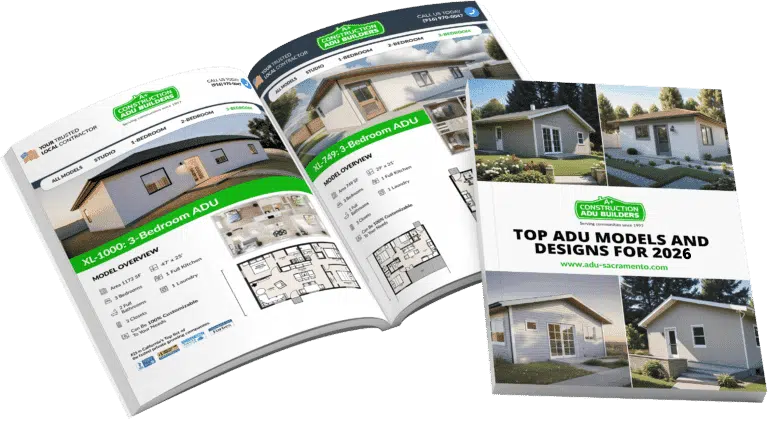
A link to download your FREE brochure will be in your inbox in 3 minutes
The final price may vary based on project specifics.
To get a free accurate quote tailored to your needs, book a consultation with us today!
The price per square foot provided is an average and may vary depending on project-specific details such as materials, location, complexity, and other factors. Actual costs may differ from the average provided.
It is recommended to obtain a detailed quote based on the specific requirements of your project.
Please note that the monthly payment displayed on this page is an estimate and is subject to variation based on the selected loan product, applicants credit score, loan amount, and other financial details. Actual monthly payment may differ from the estimate provided.
It is recommended to seek advice from a financial advisor or loan officer to obtain precise payment information tailored to individual circumstances.
 Your Trusted
Local Contractor
Your Trusted
Local Contractor
 Serving Communities Since 1997
Backyard homes – ADUs, granny flats, casitas, backyard cottages – are everywhere now.
If you’re a homeowner thinking about adding one, you’ve probably hit this fork in the road:
“Should I go with a prefab ADU… or build a custom, stick-built one?”
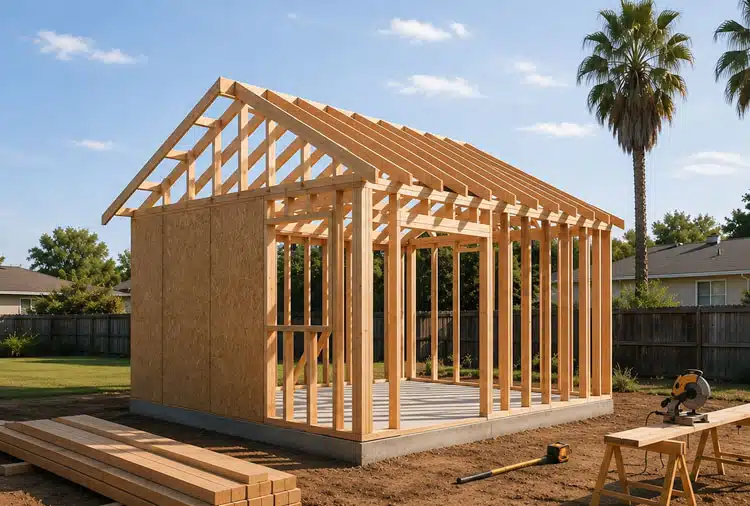
Both can give you a beautiful accessory dwelling unit. Both can follow California ADU rules. But when the goal is a backyard home built to last, there are some important differences in:
As a design–build ADU specialist in the Sacramento region, A+ Construction ADU Builders gets this question constantly. Let’s break it down in plain language so you can choose the right path for your property.
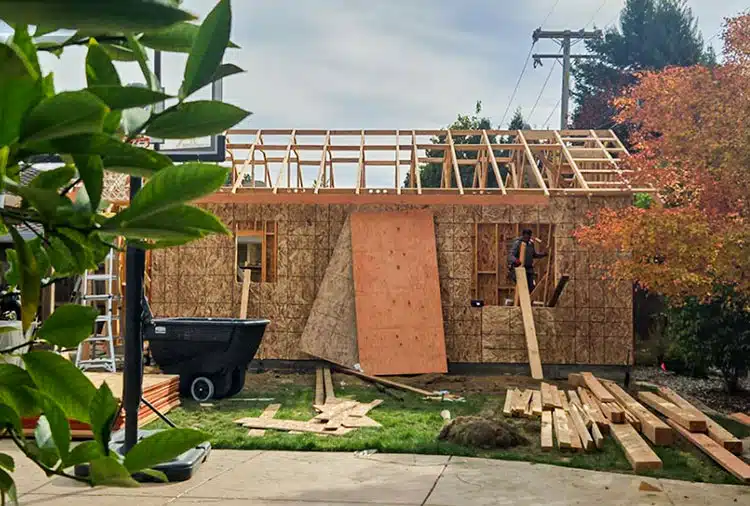
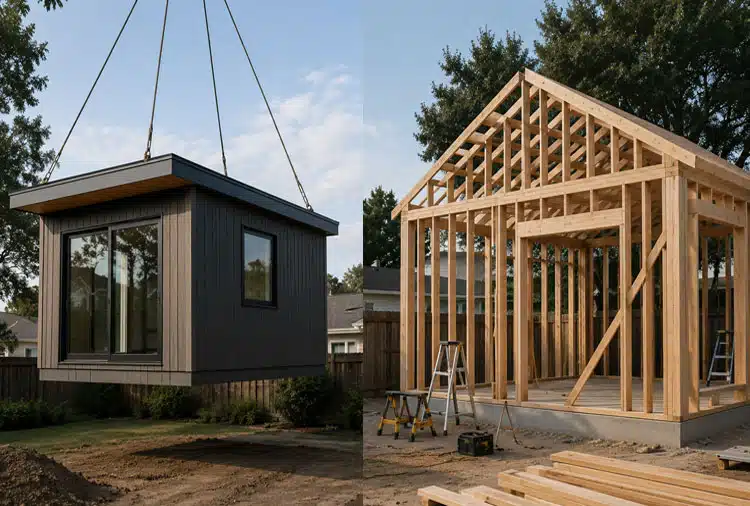
A stick-built ADU is a small house built the traditional way:
This is how A+ builds most of its ADUs: essentially a small custom home tailored to your lot and goals.
“Prefab” just means prefabricated – built, or mostly built, in a factory and then brought to your property.
That can mean:
From a homeowner’s view, the main idea is:
“A lot of the building happens in a factory instead of my backyard.”
Let’s zoom out to a 20–30 year time horizon. That’s what “built to last” really means.
Because stick-built ADUs are constructed like primary homes:
You’re not relying on proprietary parts or a specific factory being in business decades from now.
For appraisers, lenders, and future buyers, a stick-built ADU usually reads as:
“Just another high-quality dwelling on the property.”
Prefab units can be very solid, but:
For long-term value, the question becomes:
If you’re planning to hold the property for a long time, that difference matters.
With a stick-built ADU, your design can respond to:
You can tune:
…so the ADU looks like it belongs on your property, not like it landed there on a truck.
This is huge for:
Prefab and modular ADUs are typically standardized shapes designed for:
You can usually customize:
…but the big stuff – dimensions, layout, structural design – is mostly fixed.
Perfectly fine if your lot is big and simple.
Less great if you have:
This is the part many online prefab brochures gloss over.
Because materials arrive in small pieces (lumber, windows, drywall, etc.):
If your yard is awkward, heavily treed, or surrounded by power lines, stick-built often isn’t just better—it’s the only realistic option.
Modular and manufactured units need:
If your neighborhood has:
…it can be expensive or impossible to get modules in and over the house. For these sites, prefab can be a non-starter.
You’ll often see prefab ADUs advertised with a tidy “starting at $X” price. It’s tempting. But compare total project costs, not just factory numbers.
Prefab can shorten the on-site construction phase because:
That means:
If your top priority is short on-site time and your lot is easy, prefab has an edge.
Once you include:
…the final numbers for quality prefab vs quality stick-built often end up surprisingly close.
And:
For many Sacramento homeowners, stick-built ends up being the better long-term value, even if the headline prefab price looks lower at first glance.
Appraisers and buyers understand these easily:
If you plan to refinance or sell, a stick-built ADU usually gives you the cleanest story:
“This is a permanent, well-built second home on the lot.”
Prefab is getting more accepted, but you may run into:
Not a dealbreaker… but if you’re focused on maximizing equity, stick-built generally has the upper hand.
Durability / “Built to Last”
Design Flexibility
Works on Tricky Lots
On-Site Time
Appraisal / Resale Comfort
Ask yourself:
A+ isn’t just selling a product – they’re designing backyard homes meant to last in the Sacramento region.
Here’s what that looks like in practice:
Get a First Look at Real ADU Projects
 Copy Link
 Facebook
 Twitter
 LinkedIn
 WhatsApp