Citrus Heights is a well-established suburb in northern Sacramento County, about 15 miles from downtown Sacramento, with around 87,000 residents and a dense mix of single-family homes, duplexes, and apartments.
With limited vacant land but strong housing demand, Accessory Dwelling Units (ADUs) have become one of the city’s most important tools for adding homes, creating rental income, and supporting multi-generational living — especially because Citrus Heights now has its own ADU Central hub and permit-ready ADU plans.
What Is an ADU (and a JADU)?
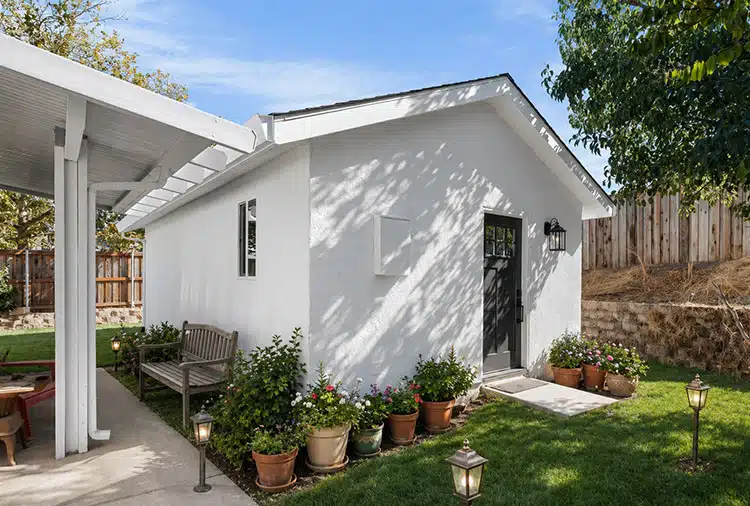
Citrus Heights defines an Accessory Dwelling Unit (ADU) as a second, permanent dwelling on the same property as a primary home, with:
- Its own kitchen
- Bathroom
- Sleeping area
- Separate, independent living facilities
The city describes ADUs as “mother-in-law units” or “granny flats” and notes that they typically range from about 220 sq. ft. studios up to 1,200 sq. ft. multi-bedroom units.
A Junior ADU (JADU) is a smaller unit created inside the existing home (including attached garages), with:
- Maximum 500 sq. ft.
- Its own outside entrance
- An efficiency kitchen
- Option to share a bathroom with the main house
- An owner-occupancy requirement (either the JADU or the main home must be owner-occupied)
Why ADUs Make Sense in Citrus Heights
Some big reasons homeowners here are pursuing ADUs:
- Built-out city, strong demand: Citrus Heights is an established commuter suburb with easy access to I-80 and major job centers, so well-located rentals are in steady demand.
- Flexible family housing: Many lots can comfortably fit a small cottage for aging parents, adult children, or caregivers while preserving privacy.
- Property value: Adding a legal ADU often increases resale value, while giving you flexibility (guest space now, rental later).
- City support: The city actively promotes ADUs via ADU Central, permit-ready ADU plans, and an ADU Amnesty Program for legalizing older units.
Can I Build an ADU in Citrus Heights?
According to the city’s ADU FAQ:
- Any property with an existing or proposed residential dwelling may have an ADU.
- The ADU can be built before, at the same time as, or after the primary dwelling.
For single-family properties:
- You may have one “standard” ADU (attached or detached)
- Plus one Junior ADU (JADU) on the same lot
For properties with two or more attached units (e.g., duplexes or apartments):
- You may be allowed up to two detached 800 sq. ft. ADUs on a single property, in addition to conversions of existing non-habitable space, under state multifamily rules.
Citrus Heights ADU Laws & Regulations (2026)
Below are the key objective standards pulled from the city’s ADU Development Standards, ADU FAQs, and current state ADU law.
Unit Types Allowed in Citrus Heights
You can generally build or create an ADU in one of these forms:
- Detached ADU – a separate backyard cottage with its own foundation
- Attached ADU – new space connected to the primary house or converted internal space
- Conversion ADU – turning an existing garage or accessory structure into an ADU
- Interior conversion ADU – carving out part of the existing home’s interior
- Junior ADU (JADU) – a ≤500 sq. ft. unit inside the existing home (often a bedroom or attached garage turned into a small suite)
Manufactured homes can be used as ADUs if they meet state standards; tiny homes on wheels are not allowed as ADUs under the city’s zoning rules.
Maximum Unit Size
Citrus Heights combines its own development standards with state minimums:
Minimum guaranteed by state law
- Every property is allowed at least one ADU of 800 sq. ft. regardless of local lot-coverage or FAR limits (as long as basic safety rules are met).
Local maximums (Citrus Heights)
- Detached ADU
- Up to 1,200 sq. ft. total.
- ADUs 800 sq. ft. or less are exempt from lot-coverage limits; larger ones must comply with the lot-coverage maximum for the zone (typically 30–50%, depending on zoning).
- Attached ADU
- May be up to 60% of the floor area of the primary dwelling, with a hard cap of 1,200 sq. ft.
- Regardless of primary home size, the city follows state minimums:
- Up to 850 sq. ft. for an attached ADU with 0–1 bedroom
- Up to 1,000 sq. ft. for 2+ bedrooms
- Junior ADU (JADU)
- Maximum 500 sq. ft., entirely within the existing or proposed envelope of the primary dwelling (including attached garage).
Density: ADUs are exempt from density calculations, so they don’t count against the maximum number of units normally allowed by zoning.
ADU Height Limits
The city’s FAQ provides updated height allowances:
- Detached ADU (ground-up):
- Up to 18 ft in height
- + 2 additional ft (up to 20 ft total) allowed to accommodate roof pitch
- ADU above a detached structure (e.g., over a garage):
- Attached ADU:
- May be up to 30 ft or to the underlying zoning’s height limit (often equivalent to a two-story home).
These standards are consistent with statewide reforms that generally require at least 16 ft minimum height allowances, with additional height permitted in many cases.
Setback Requirements
Citrus Heights uses a mix of state-minimum and local setbacks:
- Newly built detached ADU
- Minimum 4-ft side yard and 4-ft rear yard setback
- Conversion of existing structures
- No additional setback is required if you’re converting a legally built detached structure (like a garage), as long as existing setbacks meet fire-safety standards.
- Attached ADU
- Side yard: minimum 5 ft
- Rear yard: typically 20 ft, but may be reduced to 10 ft on qualifying lots (case-by-case via Planning).
- Front or street-side locations
- If the ADU is proposed in front of the primary residence or along a street-side yard, it must meet the standard front/side setbacks for that zoning district.
The city also notes that easements and utilities may require larger setbacks, and recommends not placing walls right on the minimum line to avoid survey issues during inspection.
Parking Requirements
Citrus Heights is very ADU-friendly on parking:
- No additional parking is required for an ADU, and
- No replacement parking is required when you convert a garage or covered parking into an ADU.
This aligns with state law, which exempts many ADUs from parking requirements and forbids cities from requiring replacement spaces when garages are converted.
Building Permits and Fees
You must get a building permit to create an ADU in Citrus Heights. Permits are reviewed ministerially (no public hearing) by the Community Development Department and Building Division.
Typical approvals include:
- Planning / zoning (verifying setbacks, height, lot coverage, and use)
- Building permit (structural, electrical, plumbing, mechanical, energy)
- Utility sign-offs (water, sewer, power, gas as needed)
Impact fees & permit costs
The city explains:
- ADUs ≤ 749 sq. ft.
- Impact fees are waived to encourage smaller units.
- ADUs ≥ 750 sq. ft.
- Pay reduced impact fees, calculated proportionally.
- Under state law, any ADU under 750 sq. ft. is exempt from local impact fees (parks, traffic, school, etc.).
Plan check and building permit fees still apply, and vary based on size and whether you’re doing a conversion, new construction, or manufactured unit. The city recommends contacting the Building Division for a project-specific fee quote.
Permit-ready & pre-approved plans
Citrus Heights goes beyond state requirements with its own programs:
- Permit-Ready ADU Program (PRADU):
- Offers FREE, city-pre-approved ADU plans you can use, saving thousands in design and plan review fees.
- AB-1332 Preapproved Vendor Plans:
- The city hosts an “ADU Preapproved Plans (AB-1332)” section and a Preapproved Vendor ADU List, complying with state law that requires cities to set up pre-approved ADU plan programs by January 1, 2026.
- Using a pre-approved plan can cut review times significantly; state law now requires cities to approve or deny a detached ADU using pre-approved plans in 30 days, and all other ADUs within 60 days of a complete application.
Design Requirements
Citrus Heights focuses on compatibility and privacy while keeping standards objective:
- Architectural compatibility
- ADUs should be subordinate to the primary dwelling in size and appearance, using similar materials, colors, and roof pitch.
- Entrances
- Attached ADUs and JADUs must have a separate exterior entrance from the main home.
- Window placement & privacy
- If an ADU is within 15 ft of a neighbor’s residence, window placement is restricted so windows don’t directly face each other.
- Two-story units within 10 ft of a property line must use obscure or clerestory windows on those sides unless privacy is clearly protected.
- Stories
- Detached ADUs are typically one story, though two-story options are possible (for example, an ADU over a garage) within the height limits above.
Standard California Building Code and Energy Code requirements (egress, insulation, smoke/CO alarms, etc.) fully apply.
Utilities and Infrastructure
The city’s FAQ clarifies several important points:
- Separate utility meters are not required
- But you may still choose them, especially if renting the unit separately.
- Capacity upgrades may be needed
- Existing electrical, gas, water, and sewer lines must be sized for the extra load; some projects will require panel upgrades or new laterals.
- Solar
- ADUs must meet California Energy Code requirements, including solar PV. The panels can go on either the ADU or the main house.
- Fire sprinklers
- If the primary dwelling has fire sprinklers, the ADU must have them as well. If the main house does not have sprinklers, the ADU usually won’t be required to add them just because of the new unit.
Owner-Occupancy & Renting
Standard ADUs (attached or detached)
- Citrus Heights confirms that an ADU does not have to be occupied by family and can be rented to anyone.
- State law (AB 976, now embedded in the 2025 ADU Handbook) prohibits cities from requiring owner-occupancy for ADUs, permanently removing previous 2025 sunset provisions.
- Short-term rentals are not allowed:
- The ADU must be rented for at least 31 days at a time (no traditional Airbnb-style nightly rentals).
Junior ADUs (JADUs)
- Either the primary dwelling or the JADU must be owner-occupied, and the property must record a deed restriction prohibiting separate sale of the JADU and locking in its size and attributes.
Property Taxes
Building an ADU in Citrus Heights will increase your property taxes, but only on the value of the new unit, not on the entire property’s original base.
Key tax facts:
- Under California’s Prop 13, the base property tax rate is 1% of assessed value, plus voter-approved local bonds and assessments.
- Sacramento County describes the total rate as 1% plus bonded debt for your area.
- When you build an ADU, the County Assessor usually issues a supplemental assessment for the new construction value; Citrus Heights directs homeowners to Sacramento County’s Assessor for details on these supplemental notices.
In practical terms, many owners in Sacramento County pay an effective rate around 1.1–1.3% of the new improvement’s value per year once bonds and assessments are included.
New ADU Laws in 2026 That Affect Citrus Heights
Beyond local rules, statewide ADU reforms in 2024–2025 significantly shape the Citrus Heights landscape:
- Pre-Approved ADU Plans (AB 1332)
- Requires every California city to create a pre-approved ADU plan program by January 1, 2026.
- Citrus Heights is already implementing this via its “ADU Preapproved Plans (AB-1332)” and Preapproved Vendor ADU List on ADU Central.
- Faster Permitting Timelines
- State law mandates:
- Pre-approved detached ADUs using approved plans: decision within 30 days.
- All other ADUs: 60-day ministerial review limit once the application is complete.
- No More Owner-Occupancy Requirements (AB 976)
- Permanently prohibits cities and counties from requiring owner-occupancy for ADUs, making it easier to rent both the main house and ADU.
- Legalizing Older, Unpermitted ADUs (AB 2533 & local Amnesty)
- State law creates a pathway to legalize ADUs built before January 1, 2020 if they can be brought up to health and safety standards.
- Citrus Heights complements this with an ADU Amnesty Program listed on ADU Central, giving local owners a way to work with the city to bring older units into compliance without heavy penalties.
Citrus Heights ADU Laws: Key Takeaways
For a homeowner in Citrus Heights in 2026, here’s the quick summary:
- Almost any residential property can build an ADU, as long as there’s an existing or proposed home on the lot.
- A typical single-family lot may have:
- 1 full ADU (attached or detached, up to 1,200 sq. ft.), plus
- 1 Junior ADU (up to 500 sq. ft.) inside the main home.
- Detached ADUs:
- Up to 1,200 sq. ft., 18–20 ft high, 4-ft side and rear setbacks.
- Attached ADUs:
- Up to 60% of the main home (max 1,200 sq. ft.), usually up to 30 ft tall, with 5-ft side and 20-ft (sometimes 10-ft) rear setback.
- No extra or replacement parking is required, even for garage conversions.
- ADUs can be rented to anyone on 30+-day leases, while JADUs require owner-occupancy of either the JADU or main home.
- Impact fees are waived under ~750 sq. ft. and reduced above that; your property taxes increase only on the value of the new unit, generally at about 1–1.3% per year of that added value.
 Your Trusted
Local Contractor
Your Trusted
Local Contractor
 Serving Communities Since 1997
 Copy Link
 Facebook
 Twitter
 LinkedIn
 WhatsApp